
BW to PCE: A Pragmatic First Step

BW to PCE: A Pragmatic First Step

For many SAP BW teams, modernization is no longer a question of if. It is a question of how to move forward without breaking what already works.

That is where a lot of organizations get stuck.

They know the future is cloud-based. They know SAP is positioning SAP Business Data Cloud as the path forward for SAP BW customers. They know SAP Datasphere is central to that future. But between today’s BW landscape and tomorrow’s modern data architecture, there is still a very real gap. SAP’s own messaging makes that clear: modernize at your own pace, preserve BW capabilities, and use proven migration paths rather than forcing a disruptive big-bang move.

That is exactly why BW to PCE stands out as the pragmatic first step.

It gives organizations a way to move forward without pretending that years of BW investment, business logic, process chains, extractors, and reporting dependencies can or should disappear overnight. Instead of trying to redesign everything at once, BW to PCE allows companies to establish a more manageable transition path into SAP Business Data Cloud and Datasphere. In SAP’s modernization approach, this is framed as a sequence of lift, shift, and innovate rather than one large, risky migration event.

The real challenge is not migration. It is disruption.

Most legacy BW environments are deeply woven into the business.

They support financial reporting, operational analytics, supply chain visibility, planning, and executive dashboards. Over time, they also accumulate custom transformations, special logic, data quality rules, and integration patterns that are not easy to replicate quickly in a brand-new platform.

That is why many modernization programs slow down before they even start. The technology direction may be clear, but the practical path feels messy. Teams worry about rebuilding too much, retraining too fast, or destabilizing business reporting in the process.

BW to PCE changes that conversation.

Instead of forcing an immediate full redesign, it allows organizations to preserve the BW foundation while moving into a cloud-aligned operating model. SAP’s learning content on BW modernization specifically describes a lift step into private cloud as part of the broader modernization path, and notes that a full conversion from BW 7.5 to BW/4HANA is not necessarily required before moving toward SAP Business Data Cloud.

That matters because it lowers the barrier to action.

Why BW to PCE makes sense as a first move

A lot of modernization strategies fail because they aim for the end state too early.

Leaders get excited about cloud-native data products, semantic models, AI readiness, and self-service analytics. Those are absolutely the right goals. But when the starting point is a large, business-critical BW landscape, the smartest first move is often the one that creates room for modernization without introducing unnecessary turbulence.

BW to PCE does that in a few important ways.

First, it helps organizations protect existing BW investments. Existing models, data flows, and operational processes do not need to be discarded on day one. That allows the business to continue running while IT creates a more deliberate roadmap toward Datasphere and Business Data Cloud innovation. SAP explicitly positions SAP Business Data Cloud as a way for BW customers to modernize at their own pace and continue leveraging BW capabilities in the cloud.

Second, it provides a bridge to innovation instead of a detour around it. Once BW is lifted into the private cloud component of SAP Business Data Cloud, SAP describes a path where BW data can be exposed through the Data Product Generator and consumed within the Datasphere component of BDC. That means modernization can become incremental. You do not have to choose between “keep BW” and “move to Datasphere.” You can create a transition path that connects both.

Third, it supports a lower-risk modernization model. Organizations can stabilize the landscape in the cloud first, then prioritize what to optimize, what to shift, and what to reimagine. That sequence is often far more realistic than asking teams to migrate architecture, semantics, security, integration, and governance all at once.

Where Datasphere fits into the picture

There is sometimes confusion here.

Some teams hear “Business Data Cloud” and assume BW must be replaced immediately. Others hear “Datasphere” and assume it only makes sense after BW is fully retired. SAP’s current positioning is more flexible than that.

SAP states that Business Data Cloud can include different combinations of services depending on customer needs, including SAP Datasphere, SAP Analytics Cloud, and BW/4HANA PCE. In other words, the future architecture does not have to be all-or-nothing from the start.

That is important because it creates a more practical planning model.

Organizations can use BW to PCE to bring the existing environment forward, then use Datasphere where it adds the most value first, whether that is data products, federated access, broader data integration, or new analytical use cases. SAP has also clarified that BW bridge remains supported in the context of SAP Business Data Cloud, reinforcing that BW-related capabilities still play a role in the modernization story rather than being abruptly cut off.

So the question should not be, “Do we choose BW or Datasphere?”

The better question is, “What sequence helps us modernize without creating business risk?”

For many organizations, BW to PCE is the answer to that sequencing problem.

A pragmatic roadmap beats a perfect-theory roadmap

In real transformation programs, pragmatism wins.

Not because ambition is bad, but because architecture decisions must survive budgets, timelines, resource constraints, and operational realities. A roadmap that looks elegant on a whiteboard but demands too much change too soon usually creates resistance. A roadmap that respects where the organization is today has a much better chance of moving forward.

That is why BW to PCE is such a strong first step.

It acknowledges that legacy BW environments still matter. It creates a cloud-aligned landing zone. It preserves continuity. And it opens the door to modern capabilities in SAP Business Data Cloud and Datasphere without requiring everything to be rebuilt immediately.

This is especially relevant for organizations that:

  • have large BW footprints with complex dependencies
  • want to reduce modernization risk
  • need time to phase investment and change management
  • want to align with SAP’s direction without forcing a disruptive rewrite
  • are evaluating how and when to introduce Datasphere into the landscape

Modernization does not have to begin with reinvention.

Sometimes the smartest move is not the flashiest one. It is the one that gets you moving in the right direction with the least disruption and the clearest business value.

BW to PCE gives SAP BW customers that kind of starting point.

It is not the end state. It is the pragmatic first step that makes the end state achievable.

And in a modernization journey toward SAP Business Data Cloud and Datasphere, that may be the most important step of all.

Seamless Planning in SAP

Seamless Planning in SAP: Rethinking Volume, Versions, and Performance

Planning is meant to bring clarity to an organization. Yet in many SAP landscapes today, it can gradually introduce friction. As planning models expand, versions multiply, data volumes increase, and performance becomes something teams constantly monitor rather than something they trust.

In our recent Seamless Planning in SAP webinar, Phil King from Strategy and Growth and Karthik Addula from Architecture and Delivery discussed a question that many organizations are beginning to ask: how can planning be modernized without disrupting what already works? The conversation was not centred on adding new features or layering on more tools. Instead, it focused on architecture, because architecture ultimately determines how well planning performs at scale.

SAP Analytics Cloud Planning is a powerful platform. It consolidates budgeting, forecasting, reporting, predictive capabilities, and workflow into a unified experience. However, as organizations grow and planning scenarios become more complex, certain constraints begin to surface. Large planning areas can impact responsiveness. High-cardinality dimensions affect usability. Version management becomes increasingly heavy. Model segmentation becomes necessary to manage import limits and structural complexity. There is also a technical row cap of approximately 2.1 billion fact rows, though performance pressures often appear well before that threshold is reached.

At that point, the question shifts. The issue is rarely the tool itself. More often, it is the architectural foundation supporting it.

This is where SAP Business Data Cloud enters the discussion. BDC is designed to unify and govern data across SAP and non-SAP systems, bringing together warehousing, Lakehouse capabilities, and planning foundations within a single ecosystem. Rather than having siloed systems independently feeding planning models, BDC establishes a harmonized and trusted data layer. Planning performance is not only about compute power. It is equally about how data is structured, governed, and consumed.

Within this architecture, SAP Datasphere plays a critical role. It provides a unified, semantically consistent data layer that connects SAP and non-SAP sources while preserving business meaning. Finance definitions remain intact. Logistics hierarchies are maintained. Measures and dimensions stay consistent across reporting and planning. That semantic continuity reduces duplication and strengthens trust, which is essential for planning to drive real decisions.

Seamless Planning builds on this foundation by allowing SAC planning models to be deployed into Datasphere. Fact and master data persist in Datasphere, while SAC continues to provide its planning capabilities. Plan data can flow into Datasphere workflows, and Datasphere data can be consumed in SAC models without unnecessary replication. By shifting persistence into a more scalable and governed layer, the performance conversation changes significantly. Instead of SAC carrying the full burden of large planning areas, Datasphere becomes the structured backbone.

For organizations managing high volumes, multiple versions, and complex hierarchies, this architectural shift can relieve long-standing strain. Data volume pressure is reduced. Version management becomes more sustainable. Complex logic can move closer to the database layer. Planning becomes more intentional rather than reactive.

Migration, however, requires thoughtful execution. There is no automated conversion path from BPC to SAC within this model. Logic must be reimplemented. Scripts need to be translated into SAC Data Actions and Multi Actions. Advanced database logic may need to be rebuilt within Datasphere. A phased rollout is not just recommended. It is essential. While this requires effort, it also presents an opportunity to eliminate legacy complexity and redesign planning patterns in a cleaner, more sustainable way.

A practical approach often begins with Live BPCE to familiarize users with the new interface, followed by staged logic reimplementation and selective movement of heavier logic into Datasphere. Gradual rollout across business units helps minimize disruption and strengthen adoption. Architecture ultimately succeeds only when people can confidently use it.

Seamless Planning is more than a technical feature set. It represents an architectural alignment across SAP Analytics Cloud, SAP Datasphere, SAP Business Data Cloud, and enterprise governance. When planning operates on unified, semantically governed data, performance issues tend to diminish naturally. Forecasting becomes more reliable. Scenario modelling becomes more manageable. Not because additional dashboards were introduced, but because the underlying foundation was strengthened.

Many organizations attempt to solve planning challenges by layering on more functionality or artificial intelligence. Sustainable modernization begins elsewhere. It begins with architecture, with unified data, preserved semantics, and intentional persistence.

Better planning is not created by adding more features. It is created by designing better foundations.


Access the Full Webinar

Interested in the full discussion on Seamless Planning in SAP?

Watch the complete webinar recording and explore the architecture approach using SAP Business Data Cloud, Datasphere, and SAP Analytics Cloud

Why SAP Business Data Cloud and AI Belong Together

Why SAP Business Data Cloud and AI Belong Together

Enterprise planning is undergoing a fundamental shift. Traditional FP&A platforms were designed for structured budgeting, forecasting, and scenario planning. But today, finance teams operate in an environment defined by exploding data volumes, constant volatility, and increasing pressure to apply Artificial Intelligence directly to planning decisions.

This new reality requires more than incremental improvements to existing tools. It requires a new data foundation for planning.

This is where SAP Business Data Cloud (BDC) becomes a critical enabler for AI-driven planning.

Planning Data Is No Longer Confined to the Application Layer

In traditional architectures, planning data largely lived inside SAP Analytics Cloud (SAC). While SAC provides strong governance, hierarchy management, and write-back capabilities, the data was not easily reusable at enterprise scale for advanced analytics or machine learning.

BDC changes this model.

With BDC, planning data is persisted in SAP Datasphere and exposed as governed Data Products. This means planning data can be reused, enriched, and analyzed across the enterprise without losing SAP’s financial semantics or governance.

Instead of extracts, copies, and flattened datasets, organizations now have a reliable foundation where planning data remains consistent, trusted, and ready for broader analytical use.

AI Workloads Now Run Where They Should

BDC’s native integration with Databricks introduces elastic compute for advanced analytics and machine learning.

This is a significant architectural evolution.

Rather than running simulations and forecasts on exported spreadsheets or replicated data:

  • Machine learning models operate directly on real planning and actuals data
  • Large simulations no longer impact SAC performance
  • AI workloads scale independently from finance user activity

Finance users continue working in SAC. Data scientists and AI teams operate in Databricks. Both rely on the same governed data foundation created by BDC.

What This Changes for Enterprise Planning
Planning remains SAP-native

Core planning logic, hierarchies, governance, and write-back continue to reside in SAC. Finance teams retain the control and discipline they depend on.

AI scales independently

Complex forecasting models and simulations run without affecting planning performance.

Business context is preserved

There is no hierarchy flattening and no loss of financial meaning. AI models work on semantically rich, governed data.

A true data fabric emerges

Planning data can now be blended with operational, market, and external datasets to create smarter forecasts and more adaptive scenarios.

Why This Matters for Finance Teams

The combination of BDC and AI transforms planning from a static, periodic activity into a continuously learning system.

Instead of relying on:
  • Manual projections
  • Spreadsheet-driven scenarios
  • Isolated analytical models
Finance teams gain:
  • Predictive forecasts based on real patterns in data
  • Driver-based simulations at enterprise scale
  • Continuous insight embedded into the planning lifecycle

AI is no longer an experiment outside FP&A. It becomes part of how planning works.

The Strategic Outcome

By combining SAP Business Data Cloud with AI and machine learning:

  • Finance gains speed without losing control
  • Complexity increases without sacrificing governance
  • Innovation happens without replacing core SAP processes

This is not about replacing planning.

It is about augmenting planning with intelligence.

BDC provides the architecture.
AI provides the insight.

Together, they define the next generation of enterprise data analytics and planning.

Recap: SAP Business Data Cloud + Databricks Workshop

Unlocking the Power of Unified Data & AI


A Recap of Our SAP BDC + Databricks Workshop

Some workshops are about sharing information.
This one felt different from the moment people walked in.

On November 18th and 20th, business leaders, data teams, architects, and decision-makers gathered for our SAP BDC + Databricks workshop with a shared curiosity and a shared challenge. Conversations began over coffee and introductions, quickly turning into candid discussions about real-world data problems.

Across industries and roles, one question kept surfacing:

How can organizations move faster, work smarter, and finally unlock the true value of their SAP and non-SAP data?

The energy in the room made one thing clear. This wasn’t future planning.
It was a right-now priority.

Where Most Organizations Are Today

As the sessions kicked off, we asked attendees what slows their analytics down the most. The responses were strikingly consistent, regardless of industry.

Most organizations are dealing with:

  • Data spread across SAP, non-SAP systems, and point solutions
  • Complex ETL processes that are costly and difficult to maintain
  • Rigid data models that struggle to support AI and advanced analytics
  • Multiple versions of the truth across teams
  • Delays in planning, forecasting, and decision-making

There was a sense of relief in the room as participants realized they were not alone. Different industries, same challenges. Every table had a similar story.

That set the stage for the real conversation—what’s now possible with the right foundation.

A New Foundation: SAP Business Data Cloud + Databricks

When the discussion shifted to SAP Business Data Cloud (BDC) and Databricks, the room noticeably leaned in.

This is where long-standing limitations begin to fall away.

Instead of extracting SAP data and rebuilding business logic elsewhere, SAP BDC preserves business semantics—hierarchies, relationships, calculations, and rules—and makes them available for advanced analytics and AI through the Databricks Lakehouse.

For many attendees, this was the turning point.

A moment of clarity where it became obvious that much of the complexity, they had been managing for years could simply disappear.

The session walked through how SAP BDC and Databricks bring together structured SAP data, unstructured external data, and AI/ML workloads into a single ecosystem—without expensive re-modeling or loss of business meaning. Suddenly, use cases that once felt out of reach felt practical and achievable.

Use Cases That Sparked the Biggest Conversations

Every workshop has moments where engagement spikes.
For us, it was the use cases.

Liquidity Optimization

When we demonstrated how BDC and Databricks can predict cash positions, identify supplier risk, and forecast late payments, finance leaders immediately leaned in. Questions flowed around real-time visibility and scenario planning—challenges many had been facing for years.

Workforce Analytics

This session resonated strongly with HR and operations leaders. Attrition prediction, workforce demand forecasting, and sentiment analysis—powered by unified SAP and external data—opened new ways of thinking about workforce planning cycles.

Supply Chain Risk Modeling

Proactive simulation and forecasting using internal SAP data combined with external signals struck a chord with supply chain leaders. Many shared firsthand experiences with disruptions and bottlenecks, and the ability to anticipate scenarios before they impact the business clearly resonated.

At this point, the conversation shifted.
“What if we try this?” replaced “Why is this so hard today?”

Exactly what a hands-on workshop should spark.

The Demo Everyone Was Waiting For

Concepts matter—but seeing them work is what truly lands the impact.

During the live demo, the room grew quiet in that focused, attentive way. Attendees watched as:

  • SAP data products retained their business semantics
  • Databricks applied advanced machine learning without copying data
  • SAP BDC brought insights back into business context
  • AI models and business logic worked together instead of in silos

Several participants later shared that this was the moment everything clicked—why SAP and Databricks are positioning this architecture as the future of enterprise AI.

What Organizations Must Get Right First

We also spoke candidly about the foundations required for success. Technology alone isn’t enough.

Organizations need to focus on:

  • Reducing legacy technical debt
  • Designing effective data tiering strategies (hot, warm, cold)
  • Defining clear ownership of data products
  • Establishing governance before scaling analytics
  • Modernizing operations with automation, lineage, and cataloging

This grounded the conversation. Real transformation comes from combining the right technology with the right operating model.

By this point, notebooks were open and notes were flying.

Conversations Over Dinner: Where Strategy Gets Real

A significant portion of the evening was dedicated to networking and open discussion—and this is where the workshop truly came alive.

At each table, stories emerged:

  • A CFO seeking real-time cash visibility
  • A CHRO struggling with fragmented workforce data
  • A CIO planning cloud modernization but unsure where to start
  • A supply chain leader navigating constant disruption

The tone shifted from technology overview to shared problem-solving. People connected. Strategies formed. And many realized they already had the data—they just needed a better way to bring it together.

What Attendees Walked Away With

By the end of the workshop, the takeaway was clear.
SAP BDC and Databricks aren’t just integrations. They represent a new way of using enterprise data.

Attendees left with:

  • A roadmap for unifying SAP and non-SAP data
  • Clarity on making core business processes AI-ready
  • Real examples of predictive models built on SAP context
  • A stronger understanding of governance and scaling
  • A vision for a more agile, data-driven enterprise

Most importantly, they left energized.

Advanced analytics no longer felt theoretical.
It felt practical, achievable, and within reach.

Closing Note

If you joined us in Charlotte or Nashville, thank you. Your participation made the conversations richer and the workshop truly meaningful.

If you couldn’t attend, we hope this recap gives you a sense of the experience—insightful, collaborative, and full of possibility.

And if you’d like a deeper walkthrough of SAP Business Data Cloud and Databricks for your team, Tek Analytics is always here to help.

The future of data is unified.

This workshop showed just how close that future really is.

Provisioning a Tenant for SAP Business Data Cloud (BDC)

Technical workers in server hub

Hey everyone.  Today, I am excited to share my firsthand experience in provisioning the SAP Business Data Cloud (BDC) tenant. 

(In case you are not yet familiar, SAP BDC is the unified foundation that brings together SAP Datasphere, SAP Analytics Cloud (SAC), and Databricks into one integrated ecosystem.)

In this short blog, I will walk you through the steps I took to provision a BDC tenant.

STEP 1 – Ordering Core Capacity Units

We began by ordering SAP BDC Core Capacity Units based on our organizational needs.
It’s crucial to size these units thoughtfully — considering SAC, Datasphere, and Databricks workloads collectively to ensure optimal performance and scalability.


Image of screen for requesting a BDC tenant in SAP

STEP 2 – Order Confirmation from SAP

Once the order was placed, we received confirmation emails from SAP detailing the order processing status and next steps. These notifications are key for tracking provisioning progress.

STEP 3 – Access via SAP for Me

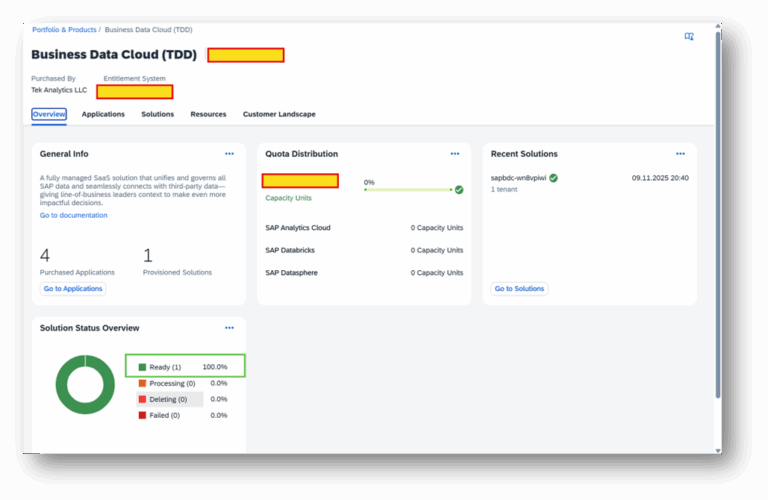
After processing, the package becomes available under your SAP for Me portal:
Portfolio & Products → My Product Packages → SAP BDC Package

This may take a few hours to reflect; once ready, you’ll notice the system status marked as “Ready.”

Image of BDC package page in SAP

STEP 4 – Login and Provisioning

From there, the BDC Cockpit can be accessed using credentials provided in SAP’s confirmation email. Within the SAP for Me → BDC Product Package section, you can seamlessly start provisioning SAC, Datasphere, and Databricks — all from a unified control point.

WHAT’S NEXT


We are now in the process of migrating our existing native Databricks use cases into SAP Databricks within the BDC environment. This will unlock native data interoperability and zero-copy data sharing between SAP and Databricks, enabling advanced AI/ML and analytics use cases with full business context intact.

Stay tuned!  Our upcoming blogs will dive deeper into the technical nitty-gritties of this journey, including architecture blueprints, configuration details, performance insights, and integration best practices.

Contact us today to learn more.  https://tek-analytics.com/contact-tek/

By – Karthik Addula, 11/10/25

Note: Tenant was provisioned under SAP Partner Licensing.


Transforming IDoc Management for Efficiency

Few of us take the time to question the IDoc process yet it remains one of the most resource-intensive parts of SAP integration. A single failed IDoc can trigger hours of manual investigation—and hundreds more could backlog overnight.   But I am really excited to tell you that it doesn’t have to be this way!

A few weeks ago, I had the opportunity to see a new product we are launching that hit the burden of managing IDoc errors head on.  Yay!  Finally, a way to address the tedium and burden.  The TEK IDoc Manager solution is focused on streamlining, automating, and simplifying IDoc error handling.  Here are the items that stood out to me about the product:

One Simple View for Smarter Workflows

The solution’s simplified editor provides a consolidated view of IDoc content on a single screen, eliminating the need for multiple SAP transactions and reducing navigation complexity. Configuration-based field management ensures each user only sees the data they need, enhancing focus and reducing errors. 

For CIOs, this translates into greater productivity and faster issue turnaround; for technical leads, it means less time spent mining through error logs to pinpoint and correct data inconsistencies. For CIOs, this translates into greater productivity and faster issue turnaround; for technical leads, it means less time spent mining through error logs to pinpoint and correct data inconsistencies.  

Accelerate Through Mass Updates and Automation

For organizations dealing with large volumes of transactional data, efficiency is critical. The mass-update capability empowers teams to correct and reprocess multiple IDocs in one streamlined action. The ability to set up rules and automated processing can further enhance efficiency.  CIOs see measurable time and cost savings, while SAP leads gain a tool that eliminates repetitive manual work and accelerates data throughput—helping ensure business continuity across integrated systems.

Enhance Partner Collaboration and Transparency

Communication breakdowns often slow down IDoc resolution. Built-in partner communication tools allow users to email business partners directly from within the system, complete with auto-populated IDoc details and side-by-side document comparisons. Technically, it’s a smooth way to align internal records with external documents. Strategically, it fosters trust, improves partner response times, and enhances data quality across the supply chain.

Configurable Control and Compliance

Every enterprise has different governance needs. The solution’s fully configurable field access ensures CIOs maintain strict control of data access, while technical teams enjoy the flexibility to adjust configurations quickly based on business rules. Fields can be set as editable or view-only according to user roles—preserving compliance and data integrity without slowing down operations.

Driving Value Across Business and IT

By merging real-time visibility, automation, and collaboration, this IDoc management solution becomes a key enabler of digital efficiency. CIOs gain a more resilient, traceable, and cost-efficient integration environment, while SAP technical teams gain tools that remove friction, reduce manual corrections, and shorten resolution cycles. 

The result: smoother data flow, faster decision-making, and a smarter way to manage every IDoc that touches your business.

 Interested in a demo or learning more about TEK’s IDoc Manager solution?  Contact Us

Real Business Use Cases Where Gen AI Makes Sense

Recently, I have been diving into how AI is reshaping the way small and mid-sized businesses run their operations. Along the way, I came across stories that feel all too familiar if you’ve ever worked in supply chain. Let me share one with you.

Meet John. On paper, everything looks organized: suppliers lined up, warehouses stocked, trucks scheduled. But anyone who has worked in supply chain knows the reality is far from neat.

One week, John is stuck with excess stock because a demand forecast was off. The next, he is buried in emails, chasing suppliers for updated delivery dates. And just when things finally seem under control, a truck breaks down on the highway, holding up an entire shipment.

Sound familiar?

Now picture John with GenAI by his side. Not as some flashy tool for show, but as a quiet co-pilot helping him handle the daily chaos of operations. Here is how his day looks different.

Morning: Demand Forecasting

John starts his day reviewing sales forecasts. Traditionally, it has been spreadsheets and static reports. But now, GenAI brings in more than just historical sales. It considers local weather, social media buzz, seasonal shifts, and even competitor campaigns.

Instead of a single guess, John sees multiple scenarios. “If rains come early, indoor products spike. If not, demand stays steady.” With that clarity, he can plan production with more confidence and less risk.

Midday: Supplier Communication

By noon, John’s inbox is full. One supplier is flagging delays at the port. Another has sent a 20-page contract revision.

Rather than combing through it all, GenAI summarizes the updates and drafts quick responses. It even highlights a critical clause change in the contract that could have gone unnoticed. For John, that means less time firefighting emails and more time strengthening supplier relationships.

Afternoon: Transportation and Maintenance

After lunch, John’s fleet manager shares concerns about one of the trucks showing irregular sensor readings.

GenAI analyzes the vehicle’s live data, compares it with past maintenance logs, and suggests:

“Truck #248 shows a high probability of axle wear in the next two weeks. Schedule replacement during its next stop.”

 Instead of risking a breakdown on the road, John avoids disruption with a proactive fix.

Evening: Rerouting Shipments

Just as the day is wrapping up, news comes in that a key highway is shut due to an accident. Normally, this would mean costly delays.

But GenAI instantly recalculates delivery routes, factoring in traffic, deadlines, and fuel costs. Drivers get updated schedules within minutes. What could have been a crisis becomes just another smooth handoff.

Training the Next Team

Meanwhile, new hires are starting in the warehouse. Instead of leafing through thick manuals, they use a GenAI-powered assistant. A quick question like “How do I process a return order?” gives them a step-by-step guide. Training becomes faster, mistakes drop, and productivity rises.

The Bigger Picture

This is what excites me about GenAI. Not the hype or flashy demos, but the real, everyday impact in John’s world: operations, supply chain, and transportation.

It does not replace people. It supports them by predicting problems before they happen, rerouting when the unexpected hits, and simplifying the overwhelming tasks that drain time.

Companies that start experimenting with GenAI in these areas will move faster than the rest. Because while others wait for the perfect AI moment, leaders like John are already solving real problems, every single day.

👉 If you are in operations or supply chain, we would love to hear: where do you see GenAI fitting into your world? Contact Us

Got Data, but No AI? Why Your Data Architecture Might Be the Problem

Got Data, but No AI? 

Are you facing this too?

It’s more common than you think.

A company kicks off an AI project.
The budget’s approved. The latest tools are in place. A smart, capable data team is ready to roll.

Everyone’s excited—AI will predict problems, streamline decisions, and cut costs.
But a few months in… things start to stall.
The ideas looked great on paper—but in practice? Nothing really works.

So, what went wrong?

It’s not the people.
It’s not the tools.
It’s not the money.

The real roadblock? The data.
It’s messy. Disconnected. Spread across silos.
And that makes it nearly impossible for AI to deliver real results.

Having Data Isn’t the Same as Using Data

These days, most companies have plenty of data. Sales records, customer details, machine logs, website clicks the list goes on. But here’s the problem: that data often lives in different systems. The sales team can’t easily see what the operations team has. The finance data is stored separately. Different formats, different rules, no easy way to connect it all.

So, when you try to use AI, it struggles. It either can’t find what it needs, or it ends up working with bad, confusing data. And that means the insights it produces don’t help the business move forward.

Why Your Data Structure Matters So Much

Think of your data like building blocks. If they don’t fit together properly, you can’t build anything strong no matter how advanced your AI tools are.

Here’s a simple comparison that shows what a weak setup looks like versus a strong one that’s ready for AI:

Weak Data Setup
Strong Data Setup

Data stuck in silos, hard to combine

Data connected across teams and systems

Outdated or messy data

Clean, consistent, high-quality data

Slow, manual preparation

Automated data flows ready for AI

Hard to get current info

Real-time data availability

Risk of compliance issues

Strong governance and secure practices

When your data is structured well, AI can deliver the insights, predictions, and automation you want.

The Hidden Costs of a Weak Data Setup

When companies don’t focus on fixing their data structure, they end up paying for it in other ways. Teams spend too much time just cleaning and organizing data instead of building AI models. The insights that come out of AI often aren’t useful because the data is messy. And delays pile up — months go by before the business sees any value from its AI efforts. All of this creates frustration across teams and wastes valuable time, energy, and budget.

What You Can Do

The good news is this can be fixed. The first step is to stop thinking of data as just an IT issue. Data is a core part of the business plan; it powers the decisions you want AI to help you make. That means planning your data setup with your AI goals in mind. Companies that succeed here often rethink how their data is connected, explore modern ways to manage and govern it, and make sure the data is accurate, safe, and up to date.

When the foundation is solid, AI can finally do what it’s supposed to help your business grow smarter, faster, and stronger.

The Big Takeaway

Having data is just the start.

If AI isn’t delivering the value you hoped for, take a closer look at how your data is structured. Fix that, and you’ll unlock the real power of AI.

Data Silos and How They’re Holding Back AI

Everyone’s Investing in AI. But Few Are Ready for It.

I’ve been doing some research lately—talking to teams, reading up on AI use cases, and honestly just observing what’s working (and what’s not) in real-world scenarios.

There’s a pattern I keep seeing.

Everyone’s excited about AI. Companies are investing in platforms, training models, and talking a lot about what’s possible. But when it comes time to use AI to solve real problems?

They hit a wall.

And often, that wall is data silos.

What Exactly Are Data Silos?

Data silos happen when information is scattered across tools, teams, or platforms—and no one’s sharing. It might not seem like a big deal at first. After all, each team knows their data, right?

But when your sales, finance, marketing, and ops data are living in separate worlds, disconnected and unaligned, your AI doesn’t stand a chance.

Even if your organization has all the right inputs, it’s like trying to build a puzzle with pieces from different sets.

Why Silos Kill AI Potential

AI isn’t magic. It needs clean, consistent, and connected data to work well.

When your data is fragmented:

  • AI models start guessing based on partial info.
  • Insights get buried in disconnected systems.
  • Decision-making becomes slower and less confident.

Silos make it nearly impossible for AI to see the full picture. And when that happens, trust in AI outcomes erodes quickly across the organization.

The Fix? You Don’t Need to Start Over

Here’s the good news: solving this doesn’t mean ripping out your current systems.

The smarter approach is to build a unified data layer—a way to connect your existing sources without forcing everything into one giant warehouse. Tools like SAP Business Data Cloud do exactly this. They let your data stay where it is, but make it visible, governable, and usable across functions.

This kind of setup means your AI can finally pull from the full context—not just fragments.

Get Clear on Ownership and Definitions

Tech alone doesn’t fix the problem. You need clarity on who owns what data, how it’s maintained, and how it’s defined.

Something as simple as the word “customer” can mean five different things across teams—and that kind of inconsistency can throw off everything from sales forecasting to churn prediction.

Building shared definitions and clear ownership ensures your AI models are working with reality, not assumptions.

Bring AI Into the Business, Not Just the Lab

AI can’t sit on the sidelines. To create impact, it needs to be embedded directly into your workflows—supporting things like planning, demand forecasting, pricing, or customer retention.

This shift from AI as an experiment to AI as a core part of business operations is where real ROI begins to show up.

You Don’t Need More Data. You Need Better Data.

Most companies already have plenty of data. But it’s not about volume—it’s about how that data connects and flows.

That’s the real unlock for AI.

When your data is silo-free, your AI can move faster, learn faster, and deliver smarter insights that drive results.

Let’s Build a Smarter Foundation

At Tek Analytics, we help businesses go from siloed and stuck to smart and scalable—using data platforms that are built for AI success.

If your team is exploring how to make your data AI-ready, let’s have a conversation.

Because the best AI strategy? Starts with the right data foundation.

What Is Gen AI and Why Care

By – Sai Srinija Potnuru
 
What Is Generative AI and Why Should Organizations Care?

Let’s face it—we’re living in a world where AI isn’t just a sci-fi buzzword anymore. It’s real, it’s here, and it’s already changing how businesses operate—fast.

And at the heart of this shift? Generative AI (or GenAI, as we like to call it).

But what *is* it really? And more importantly—why should your organization care?

 
So… What Is GenAI?

GenAI is a type of artificial intelligence that doesn’t just analyze data—it *creates*. We’re talking text, images, code, video, audio, even 3D models. It’s the engine behind tools like ChatGPT, DALL·E, GitHub Copilot, and more.

Instead of just answering questions, GenAI collaborates. It learns from massive datasets and responds in human-like ways—drafting emails, summarizing reports, writing code, and generating ideas that honestly feel… creative.

In short? GenAI is a productivity booster that helps people get more done—faster, smarter, and with more impact.

 
Why Should Your Org Care?

Because GenAI isn’t just another tech trend. It’s a fundamental business shift. And if your competitors aren’t already testing it out… they will be soon.

Here’s what GenAI is bringing to the table:

1. Things Get Done—Way Faster GenAI cuts hours off repetitive tasks. Instead of manually formatting that 20-page report? Let AI do the heavy lifting, so your team can focus on the good stuff—like strategy and innovation.

2. Creativity Gets a Major Upgrade Need a dozen ad copy variations? Personalized emails for different customer segments? A fresh product description that actually stands out?

Done, done, and done. GenAI acts like a creative partner—not a replacement—but a powerful one.

3. Personalization at Scale This is where GenAI really shines. It helps you deliver customized experiences to thousands of people—without losing the human touch. Smarter bots, adaptive learning, AI-curated recommendations… even at enterprise scale, your users will feel like you’re speaking directly to them.

 
Real-World Use Cases (That Aren’t Just Hype)

Still feels a bit abstract? Let’s talk about what this looks like in the real world:

  • Retail: Personalized promotions, 24/7 human-sounding support, auto-generated product descriptions
  • Finance: AI-driven risk summaries, plain-language policy explanations, market trend recaps
  • Manufacturing: Auto-generated manuals, predictive maintenance alerts, real-time scenario planning

This isn’t “someday” stuff. It’s happening *right now*—and it’s working.

 
So… What’s the Catch?

With great power comes—yep, you guessed it—responsibility.

GenAI is powerful, but it needs strong governance. Ethics, bias monitoring, data privacy, transparency… these aren’t optional. They’re essential for building trust and staying compliant.

That’s why leading orgs are investing in AI Centers of Excellence, building responsible AI frameworks, and upskilling their teams to lead the charge.

 
Our Take? You Don’t Have to Be First—But You Can’t Be Last

GenAI isn’t a passing trend. It’s a tectonic shift in how work gets done.

Organizations that start exploring now will shape the future. The ones that wait? They’ll be catching up in a world that’s already moved on.

Whether you’re just curious or ready to scale, now’s the time to start asking the big questions about how GenAI can support your business.

Because the real question isn’t *if* you’ll use GenAI… it’s *how soon* you’ll make it work for you.